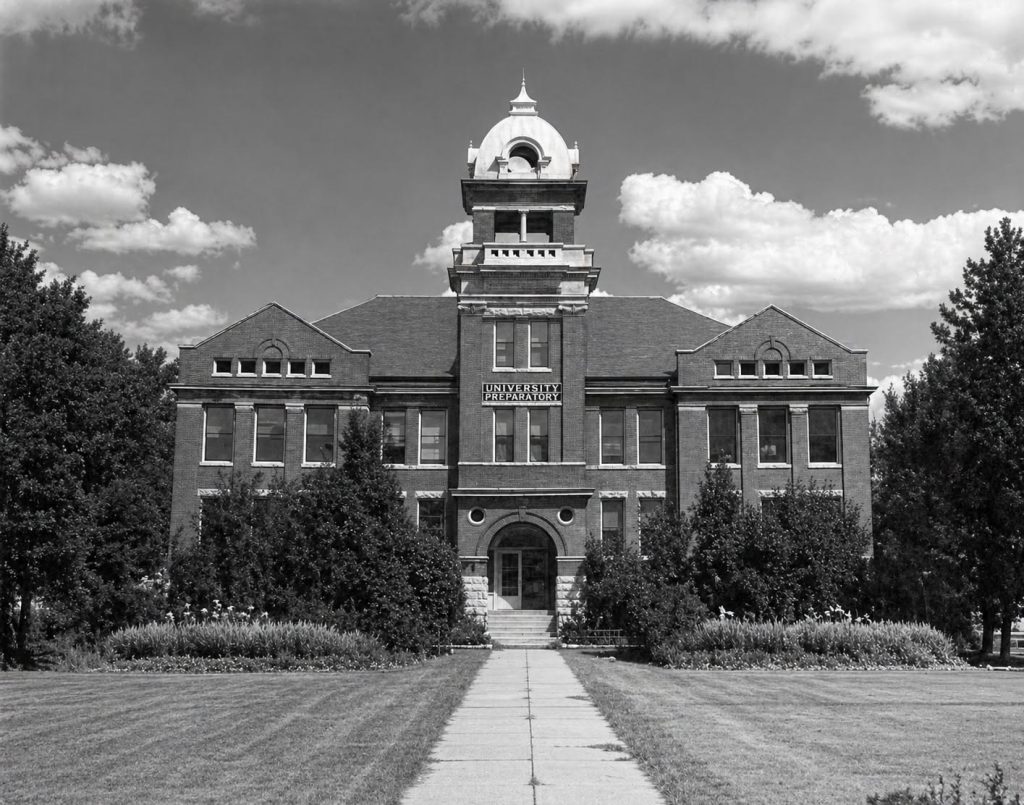
A view of Central Hall on the NOC Campus when NOC was the University Preparatory School.
Northern Oklahoma College: 125 Years of History
Northern Oklahoma College will celebrate its 125th anniversary Oct. 3 with a 6:30 p.m. Quasquicentennial Concert at the Kinzer Performing Arts Center on the NOC Tonkawa campus.
The celebration marks 125 years since an institution originally created to prepare students for a university education began a journey that would eventually make it Oklahoma’s first community college and a multi-campus institution serving students in Tonkawa, Enid and Stillwater.
NOC’s story began shortly after the opening of the Cherokee Outlet, when settlers in the Tonkawa area began looking beyond the immediate necessities of establishing farms and communities and toward educational opportunities for their children. By 1900, area residents were concerned about the need for secondary education. Territorial representative James Wilkin became a leading advocate for establishing a school in Tonkawa and introduced legislation creating the University Preparatory School. The bill passed and was signed by Territorial Gov. Cassius Barnes in the spring of 1901. One of the school’s original purposes was preparing students to transfer to the University of Oklahoma.
The school’s first Board of Regents purchased 20 acres on the east side of Tonkawa from Thomas Martin for $1,500. Construction began on Central Hall in 1901, and the building was completed in March 1902 for $23,000, including furnishings. James Herbert Kelley was selected as the first president and spent the summer of 1902 traveling the countryside by buggy recruiting students. When classes began, 217 students were enrolled and seven faculty members joined Kelley, who also taught science and psychology.
Growth came quickly. Enrollment reached 410 by 1904, requiring additional facilities. That same year, the school held its first graduation exercises in a large tent. More than 900 people attended the three-day celebration, which included athletic events, debates and a baccalaureate before 17 graduates received diplomas. Fine arts and athletics also became important parts of campus life. Football began in 1904, and early teams competed successfully against schools including Oklahoma A&M and the University of Oklahoma. The institution’s reputation grew to the point that it was sometimes known as the “Little Harvard of the Plains.”
The young school nearly disappeared during its second decade. Wilkin Hall burned in 1914, and political efforts were underway to eliminate several state-supported schools. In 1917, the school’s appropriation was not approved and its doors closed. Approximately 65 students went into military service during World War I, with four losing their lives. Equipment, furnishings, the library and printing plant were sent to other state institutions.
The closure was not permanent. The Oklahoma Legislature approved funding to re-establish the school in 1919, and during the 1920s the institution took an important step toward becoming the college it is today. In 1921, the school became the University Preparatory and Junior Vocational College, beginning its transition from a preparatory school into higher education. The decade coincided with dramatic growth in Tonkawa following discovery of the Three Sands Oil Field. The city’s population grew from approximately 1,800 in 1921 to more than 10,000 by 1923.
The college continued to develop through the Great Depression and World War II. Enrollment grew during the 1930s, while academic programs, fine arts and student activities expanded. During World War II, the college offered civilian aviation training, with ground school on campus and flight instruction in Ponca City and Blackwell. The program eventually became part of the Cadet Air Corps training effort. Following the war, returning veterans arrived on campus through the GI Bill and brought new growth to the institution.
Another major change came in 1941 when the school became Northern Oklahoma Junior College. The remaining high school curriculum was gradually eliminated, ending in 1950. The postwar years brought new facilities and programs, including agriculture, student organizations and broadcasting. In 1956, the college opened Easterling Hall and the Memorial Union, and the institution’s band later represented Northern in the Rose Bowl Parade.
Perhaps the most important transition in the modern history of the institution occurred in 1965. Dr. Edwin E. Vineyard became the college’s 10th president, and the school’s name officially changed to Northern Oklahoma College. Vineyard’s early years included significant challenges, but by 1967 NOC had regained full accreditation. The campus expanded with a new student union-cafeteria complex, residence halls and Crowder Science Hall.
The following decades brought continued growth in academics, fine arts, athletics and student life. In the 1970s, high school students were allowed to enroll for college credit for the first time, NOC received a 10-year accreditation from the North Central Association, and the Lady Mavericks basketball team won a national championship in 1978. By fall 1979, enrollment had reached 1,635 students.
Fine arts remained an important part of campus life, with the Roustabouts performing nationally and internationally leading to the construction of the Kinzer Performing Arts Center. The 1990s brought expanded agriculture facilities, new academic programs and significant growth in athletics, including the addition of baseball, softball and men’s and women’s soccer.
NOC’s reach changed dramatically during the 1990s with the purchase of the former Phillips University campus in Enid. Northern had offered classes in Enid previously, but the acquisition—made in partnership with the City of Enid and the Oklahoma State Regents for Higher Education—gave NOC a permanent second campus. Enrollment across Tonkawa and Enid grew to approximately 3,000 students.
The college became a three-campus institution in the next decade with the creation of the NOC/OSU Gateway Program in Stillwater in cooperation with Oklahoma State University. The period also brought additional facilities in Tonkawa and Enid and continued expansion of academic opportunities. By the early 2010s, the institution that had opened with 217 students in a single building had grown into a multi-campus college serving thousands.
NOC has continued to evolve in recent years. Dr. Cheryl Evans became the institution’s first female president in 2011 and served for a decade. The Pickens Learning Commons opened on the Tonkawa campus in 2022, combining contemporary student learning space with a significant art collection. Diana Morris became NOC’s 15th president in 2024 and was formally inaugurated in January 2025.
In November 2025, NOC received a $17 million unrestricted gift from philanthropist MacKenzie Scott, the largest gift in college history. As the college entered its 125th anniversary year in 2026, it continued adding chapters to a story that began with a territorial legislator’s belief that young people in northern Oklahoma needed greater educational opportunities.
Other anniversary events include a Silent Auction/Purse Raffle at the Renfro Center from 3:30 p.m. – 5:30 p.m. to raise funds for the First-Generation Scholarship and Program Support. Also, the Eleanor Hays Art Gallery will open its doors for an Historical Exhibition, September 22 – December 8, 2026, in the Kinzer Performing Arts Center on the Tonkawa campus. The exhibit is open from 1 p.m. – 5 p.m. daily and during events in the performing arts center.
Northern Oklahoma College, the state’s first public two-year community college, is a multi-campus, land-grant institution that provides high quality, accessible, and affordable educational opportunities and services.
NOC serves nearly 3,100 students through the home campus in Tonkawa, branch in Enid, and NOC/OSU Gateway Program in Stillwater. Of these students about 85% receive financial aid and/or scholarships. 69% of NOC students complete their degree with zero debt.
The college is accredited by the Higher Learning Commission and offers associate degrees in three general areas: Arts, Science and Applied Science; the Accreditation Council for Business Schools and Programs; and the Accreditation Commission for Education and Nursing.
For more information about Northern Oklahoma College or giving to the NOC Foundation, please contact the development office at (580) 628-6208 or visit the NOC website at www.noc.edu.
-30-